From the late 16th century onwards, significant changes began in the Ottoman Empire’s provincial administration. Until this period, the provinces had been governed by administrators appointed from the capital, İstanbul, within the framework of the tımar system. However, various factors such as population growth in the 16th century, advancements in warfare technology, the increasing significance of firearms, prolonged wars compared to previous times, and the influx of precious metals into Europe following the geographical discoveries and leading to rising prices, presented challenges for the Ottoman Empire. Changes in provincial administration became necessary to address these issues and meet new demands. As a result of these developments, the state required a more substantial and regular revenue stream compared to previous periods. Consequently, from the early 17th century, the tımar system (Ottoman land tenure system) began to dissolve and was gradually replaced by the iltizam system (Ottoman tax farming system).
The increasing prevalence of the iltizam system, which was based on selling tax revenues in advance for a specific period, gradually diminished the influence of the capital in the provinces and, in contrast, led to the rise of a new class known as the âyan. This situation was further reinforced, particularly after the Second Siege of Vienna and the prolonged period of warfare that followed, making the âyans (local notables) the political and administrative rulers of their respective regions. Throughout the 18th century, the growing power of the âyans against the central authority was further solidified with the proclamation of the Sened-i Ittifak in 1808, which officially recognized and secured their status.
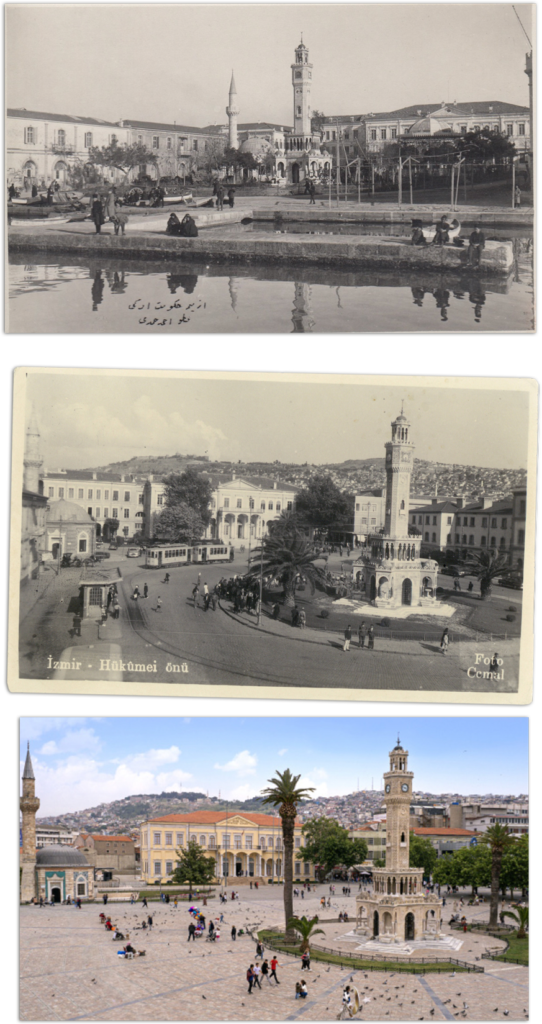
The process in İzmir followed a similar course to other provincial regions. Particularly from the second half of the 18th century onward, the Kâtipzade family took control of the administration of İzmir. The name of İzmir’s Konak district derives from the word ‘konak’ (mansion) that served as the family’s residence. Today, the İzmir Government Mansion stands where this konak (mansion) once existed. As a result of the developments in the 19th century, this area transformed into Konak Square, becoming İzmir’s modern administrative center.
The Ottoman Empire, facing the growing power of Russia and the nationalist movements that emerged after the French Revolution, entered a reform process that would result in the reorganization of the state. This process began with Nizam-ı Cedid and was briefly interrupted by Sened-i İttifak but gained momentum with the abolition of the Janissary Corps (Yeniçeri Ocağı) in 1826. It continued with the Tanzimat and Islahat edicts and stabilized with the establishment of modern state institutions. The most significant reflection of this process in the provinces was the establishment of a modern provincial administration and organizing the new army that replaced the Janissary Corps. With the promulgation of the Vilayet Law in 1864, the eyalet (state) system was abolished and replaced by vilayets (provinces). This regulation, regarded as the beginning of modern provincial administration in Türkiye, designated İzmir as the center of the newly established Aydın Vilayeti. As İzmir became a vilayet center, the area where the Kâtipzade Mansion stood—now known as Konak Square—transformed into a modern administrative center, a role it continues to hold today.