
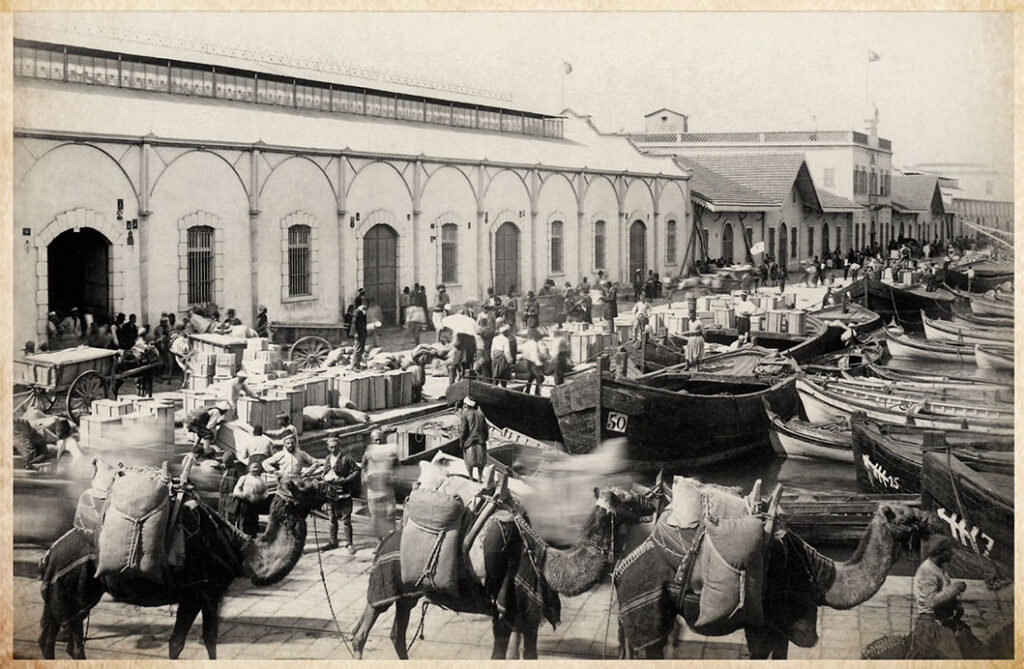
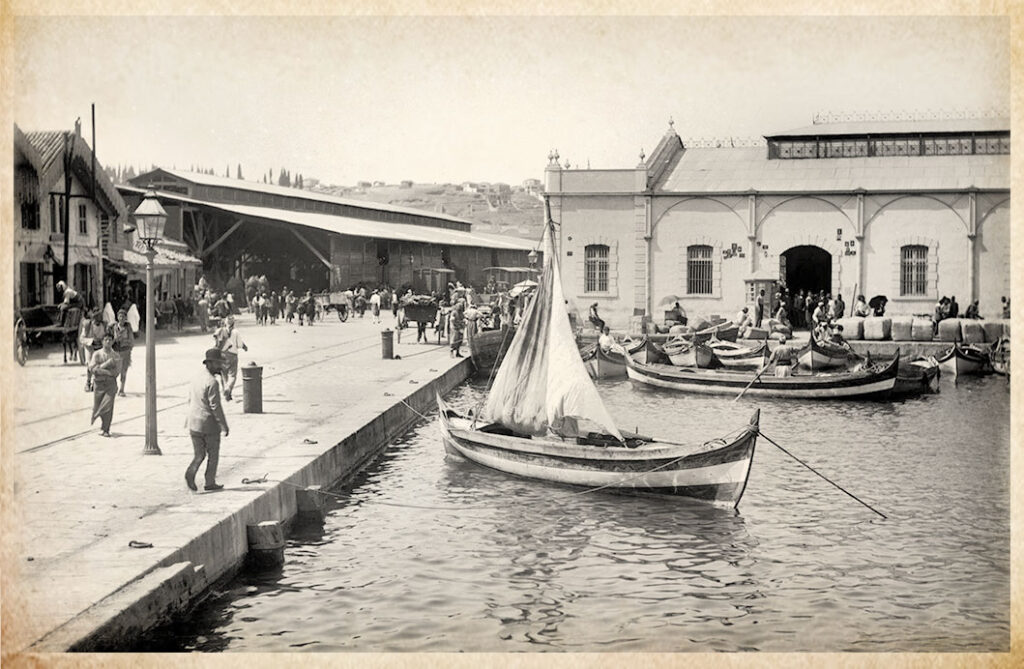
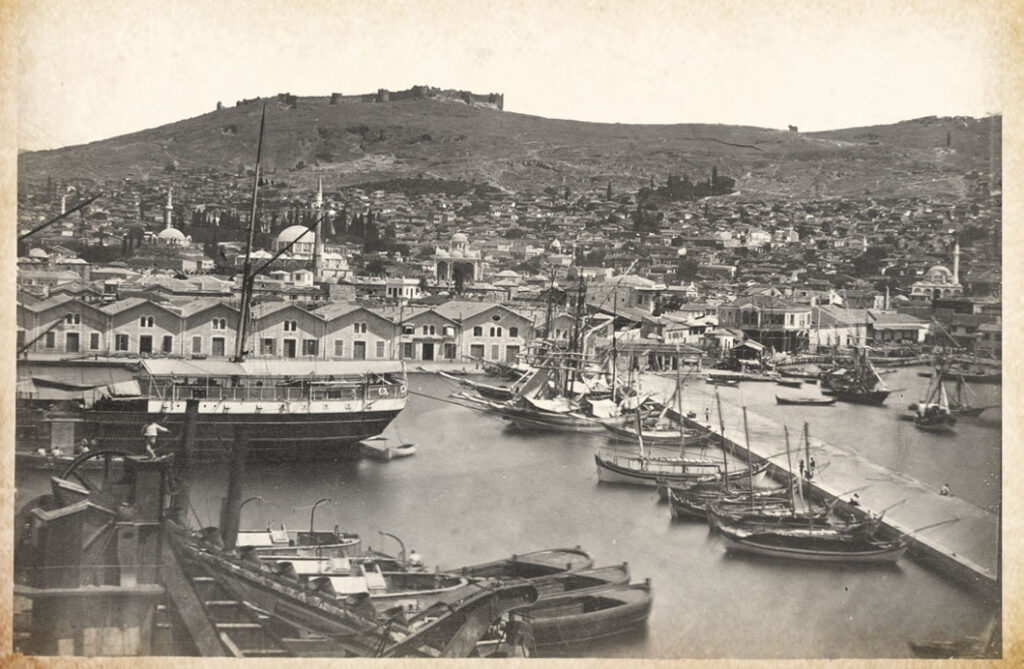
When İzmir’s first modern port became operational in 1876, two small wooden buildings within the same area were used as customs buildings. In 1878, a new concession agreement was signed with the Dussaud brothers, who had constructed the first phase of the port to build the second phase. As part of this agreement, a decision was made to build a modern customs building and warehouses. The newly constructed customs building and warehouses, which were inaugurated in 1880, eventually became insufficient to meet the growing needs. As a result, new structures were built on land reclaimed from the sea, and by 1913, the expanded area had taken mainly its final form.
The İzmir customs building, which shares a similar architectural design with other customs buildings and warehouse structures constructed in various cities of the country during the same period, consists of structures built at different times along a straight line extending from land towards the sea. Until the 1950s, the building was primarily used for customs operations, but later, it served as the city’s fish market for a long period. Many residents of İzmir remember this building as a fish market. In the early 2000s, the structure underwent extensive restoration, and since 2004, it has continued its existence as a shopping mall known as Konak Pier.
Aydın Train Station
Logistics infrastructure has always been as crucial for the development of trade in the past as it is today. With the commissioning of the İzmir-Aydın and İzmir-Kasaba (Turgutlu) railway lines, the increasing volume of trade necessitated a new port. Once the port was operational, the need arose to connect with the railway network. A railway line was constructed between Alsancak Station and the İzmir customs building to facilitate this connection. This line, which crossed the Kordon Promenade to reach the port, was used by trams for passenger transportation during the day and freight trains at night.
As seen in the modal, the building complex identified as Aydın Train Station, located in the rear right section of the İzmir customs building as seen in the model, consisted of three structures. The building on the far left was used as an office, while the one on the far right functioned as a workshop. The large structure in the middle served both as the final station for freight trains and as a warehouse. Freight transportation from Alsancak to the port continued until 1910. After this date, freight transport was prohibited, and the central building continued to be used as a warehouse until the 1950s.
Other Structures
The group of buildings located in the rear left section of the İzmir customs building, as seen in the model, was associated with four different institutions. On the far left were the buildings known as the Aliotti Warehouses, which, as the name suggests, were used as a warehouse complex. The Aliotti family, which gave its name to these warehouses, was a Levantine family that came to İzmir from Italy for trade in the 19th century. Some family members founded the İzmir-based Oriental Carpet Company, one of the largest carpet companies in the world at the time, and continued to live in Türkiye and engage in various commercial activities until the year 2000. The mansion located on the Karşıyaka waterfront today, owned by the Yaşar Education and Culture Foundation (Yaşar Eğitim ve Kültür Vakfı), was built by the Aliotti family in 1915. The mentioned warehouses remained in use until the 1950s but were demolished due to road construction works.
Next to the Aliotti Warehouses stood the two-story administration building of Waterfront Company, which was involved in constructing the quay and the tramway. Adjacent to it were Haralambo Yossifoğlu Han and wooden structures that served as cafes and taverns. Like other buildings in the area, these structures were also demolished as part of road construction projects.