
The word Levant, of French origin, means “east,” referring to the place where the sun rises. In geographical terminology, this word has been used to describe the region located to the east of Italy, in other words, the Eastern Mediterranean.
Throughout history, cities located along trade routes between the east and the west have become major centers of attraction in their regions. İzmir’s emergence onto the historical stage in modern times is closely linked to its position along these trade routes. Due to the impact of the Ottoman-Iran War, caravans began to favor İzmir as an alternative to Aleppo, and from the 17th century onward, the volume of trade centered in İzmir steadily increased.
As trade expanded, so did the city’s population. Many European merchants arrived in İzmir for trade, and some eventually settled there. As the number of foreign merchants living in the city increased, several European states, primarily Britain and France, established diplomatic missions in İzmir.
The Baltalimanı Agreement, signed between the Ottoman Empire and Britain in 1838, marked a significant turning point in the development of trade centered in İzmir. This agreement abolished export restrictions and allowed British merchants to purchase and export any goods they desired. The scope of this privilege was soon extended to include other European states. As a result, the Ottoman Empire became a key supplier of raw materials for the growing European industry, and İzmir transformed into the most significant trade hub in the Mediterranean for exporting these materials to Europe. Consequently, the city began to be referred to as the “Capital of the Levant.”
Changes in the volume and nature of trade created new demands, and in response, İzmir underwent significant urban development starting from the second half of the 19th century. With the introduction of the İzmir-Aydın and İzmir-Kasaba (Turgutlu) railway lines, the increasing trade volume necessitated the construction of a new port. Alongside the development of the port, the Kordon Promenade—one of the most iconic locations associated with İzmir today—emerged. Many new institutions required by the evolving trade structure found their place in newly constructed buildings along Kordon. Accompanying these developments, a modern administrative center took shape, leading to the formation of Konak Square, which remains the heart of the city today.
Some structures that defined İzmir during this period still stand today, while others have been demolished over time and replaced with new buildings. Nevertheless, Pasaport, Konak Square, and Kordon Promenade, which took shape during this era, continue to serve as symbols of İzmir’s urban identity, remaining integral to both the city’s daily life and its cultural memory.
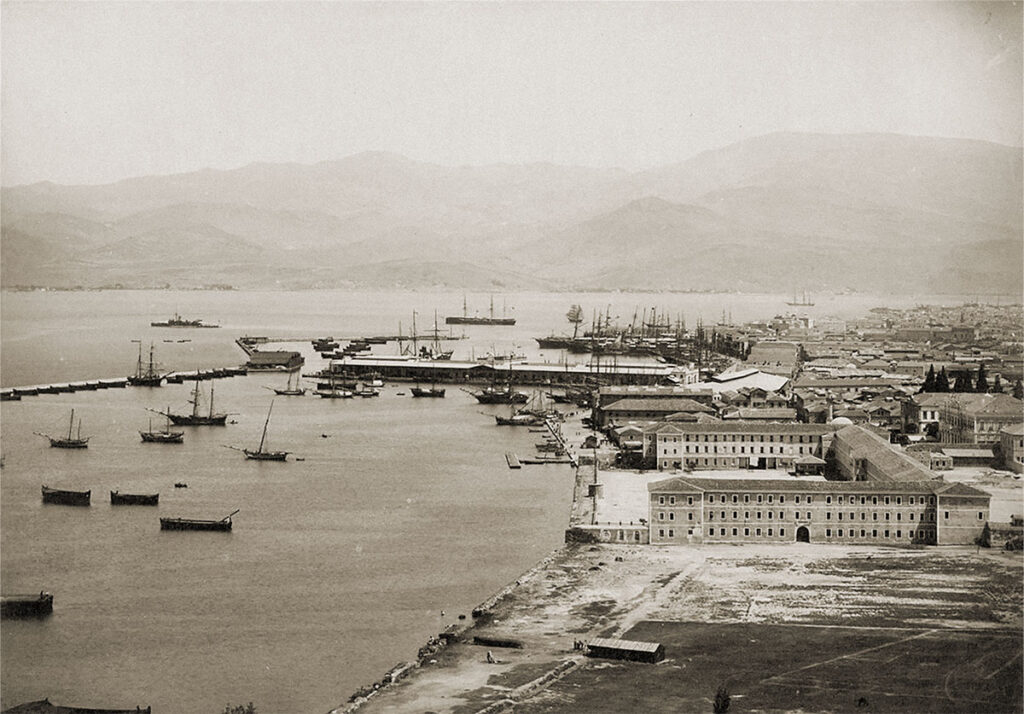
The Port of İzmir After the Construction of the Quay, Sébah & Joaillier, 1890-